Cloud Deployment Options for OpenText: OCP, Private Cloud, and Everything In Between
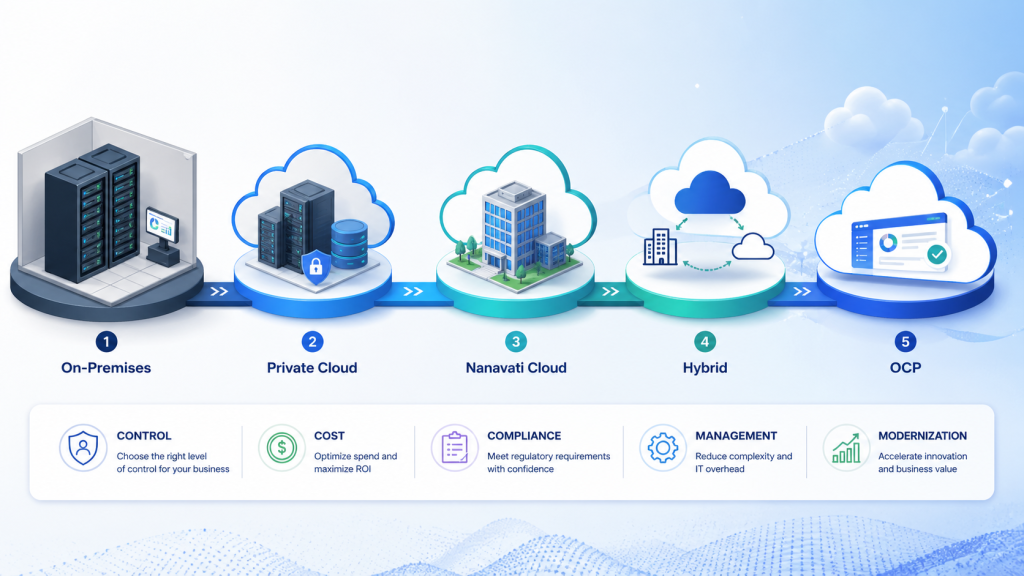
For most organizations running OpenText Content Management, the question is no longer whether to move to the cloud. It is which cloud, and on whose terms. The deployment landscape for OpenText has matured considerably. Today, organizations can choose from a spectrum of options: staying on-premises, moving to OpenText’s own managed cloud platform (OCP), deploying in a private cloud, adopting a hybrid model that bridges both worlds, or working with a trusted partner-hosted cloud like the Nanavati Cloud. Each path has real tradeoffs, and the right answer depends on your compliance requirements, budget, IT capacity, and long-term strategy.
This article walks through each deployment model clearly and honestly, including where the Nanavati Cloud fits as a legitimate alternative, so your organization can make an informed decision.
The Deployment Spectrum
OpenText formally recognizes four deployment paths: on-premises, private cloud, public cloud (which includes OCP), and hybrid. In practice, the market has added a fifth option that many organizations overlook: partner-hosted managed cloud services like the Nanavati Cloud, which sits between fully self-managed private cloud and the full SaaS commitment of OCP. Understanding where each sits on the spectrum of control, cost, and complexity is the starting point for any deployment decision.
On-Premises: Maximum Control, Maximum Responsibility
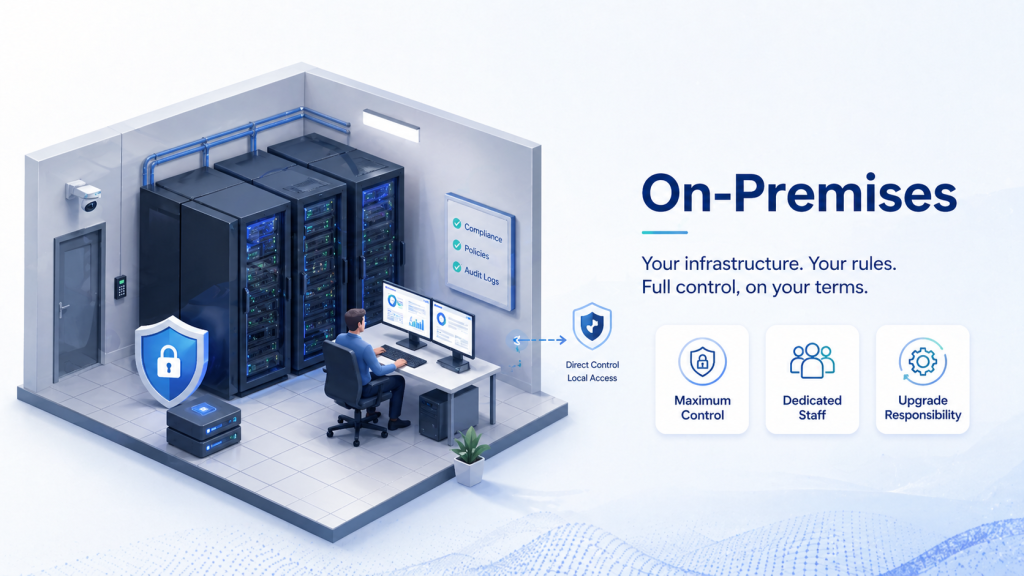
On-premises deployment remains a viable and actively supported option for OpenText Content Management. Your infrastructure, your servers, your data center: everything is under your direct control. For organizations with strict air-gapped security requirements, classified environments, or very specific data residency mandates that no cloud provider can satisfy, on-premises is not just an option. It is the only option.
The tradeoffs are well understood. You carry the full burden of hardware procurement, software upgrades, patching, disaster recovery planning, and the specialized staffing required to keep everything running. Upgrades that are automatic in cloud environments require planned maintenance windows, project budgets, and dedicated technical resources. As OpenText’s release cadence has accelerated, with new versions arriving quarterly, keeping an on-premises deployment current demands a sustained investment that many IT teams find increasingly difficult to justify. That said, for organizations with the staff and budget to manage it, on-premises continues to offer capabilities and integration flexibility that cloud models do not always match.
OpenText Cloud Platform (OCP): The Fully Managed SaaS Path
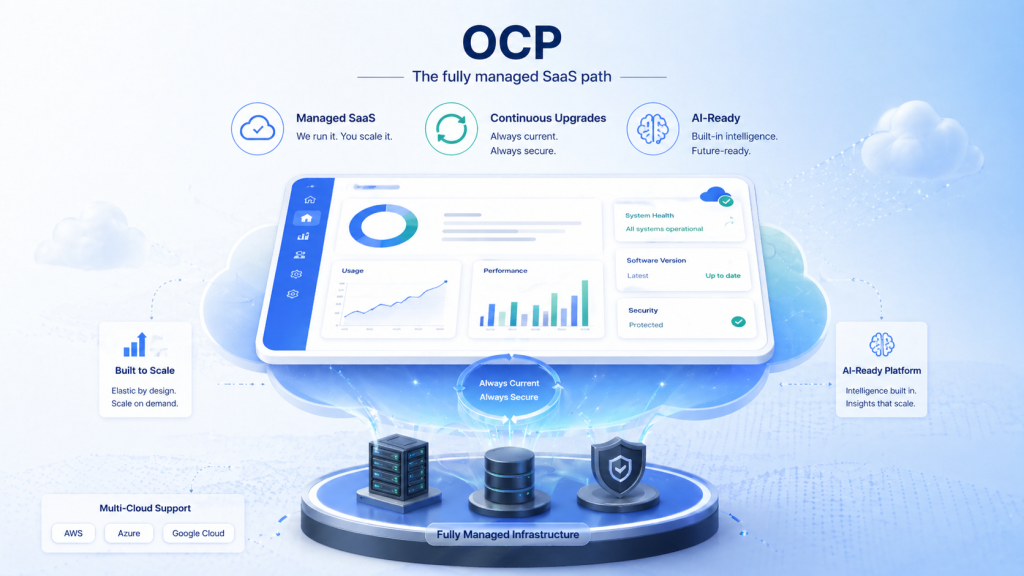
The OpenText Cloud Platform (OCP) is OpenText’s own multi-tenant SaaS environment, built on hyperscaler infrastructure across AWS, Microsoft Azure, and Google Cloud. It is OpenText’s strategic direction for the platform, and an increasing number of newer capabilities, including the Online Editing Service for co-authoring, are being delivered exclusively through OCP first. If AI-powered features like OpenText Content Aviator and the broader OpenText AI Data Platform are on your roadmap, OCP is the environment where those capabilities are native and most deeply integrated.
OCP operates on a subscription licensing model, and OpenText handles all infrastructure management, patching, upgrades, and availability. Organizations get the benefit of always being on the current version without the project overhead of manual upgrades. High availability is built in, with secondary data center failover and defined service restoration objectives. For organizations moving to OCP, security and compliance responsibilities are shared. OpenText manages the platform layer while customers retain responsibility for their own data governance and access controls within the environment.
The key consideration for OCP is the subscription model itself. Organizations with existing perpetual licenses need to evaluate the cost of transitioning, and those in highly regulated sectors, particularly federal agencies requiring FedRamp authorization or Protected B compliance, should confirm that specific OCP tenants and configurations meet their requirements. OCP is not a single-tenant environment by default, which matters for certain compliance frameworks.
OpenText Private Cloud: Dedicated Infrastructure, Managed by OpenText
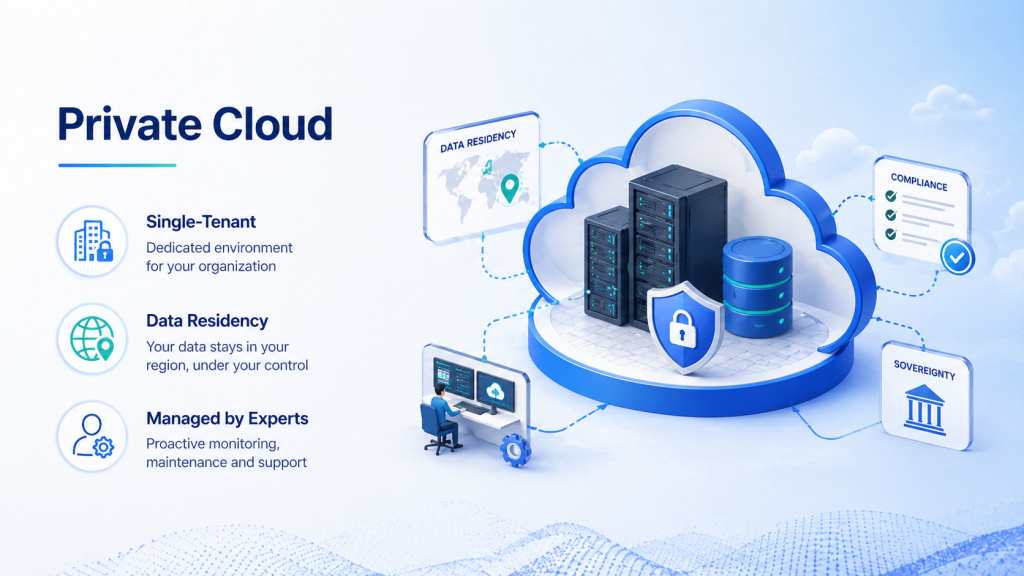
For organizations that want the operational simplicity of a managed cloud service but cannot accept a multi-tenant environment, OpenText Private Cloud is the answer. Introduced with significant enhancements in mid-2025, OpenText Private Cloud provides dedicated, single-tenant infrastructure managed by OpenText’s own CloudOps team. Your data stays in a designated jurisdiction, meeting data sovereignty and residency requirements for regulated industries operating across multiple geographies. Full data residency, sovereign AI capabilities through OpenText Aviator, and integration with on-premises systems through a hybrid model are all supported.
OpenText reports that customers transitioning to Private Cloud typically see IT cost reductions in the range of 30 to 40 percent compared to self-managed on-premises deployments, driven by elimination of hardware costs, shared operational expertise, and continuous optimization of resource utilization. Customers can retain existing perpetual licenses in many Private Cloud configurations, which eases the financial transition compared to a full OCP subscription shift. The tradeoff relative to OCP is that Private Cloud is a more tailored, higher-touch engagement: provisioning and onboarding timelines are longer, and costs reflect the dedicated infrastructure rather than multi-tenant economies of scale.
Hybrid Deployment: The Best of Both Worlds, With Added Complexity
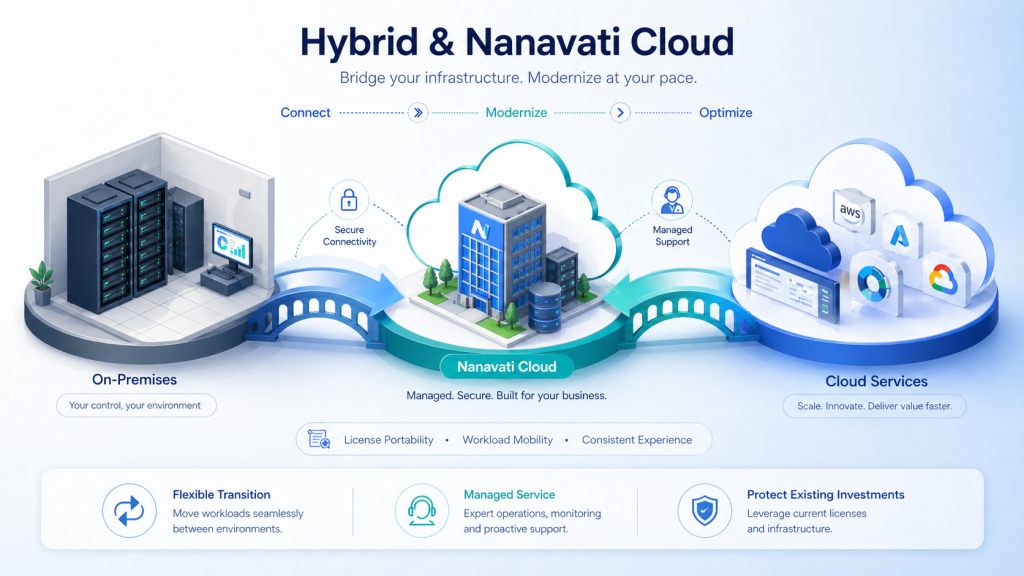
A hybrid deployment connects an on-premises or private cloud Content Management environment with cloud-based services, whether that is OCP for specific workloads, Microsoft Azure AD for identity, or cloud-based storage tiers for archival content. Hybrid is increasingly the practical reality for large enterprises that have significant on-premises investments and are moving incrementally toward the cloud rather than executing a single lift-and-shift migration.
The appeal of hybrid is clear: you can modernize at your own pace, keep sensitive or regulated data on infrastructure you control, and still access cloud-native capabilities for appropriate workloads. The challenge is that hybrid environments require careful architecture to manage connectivity, security, and consistency across boundaries. Organizations pursuing hybrid deployments benefit significantly from working with experienced implementation partners who have done it before. Misconfigured hybrid environments are a common source of performance, security, and compliance issues that are expensive to remediate after the fact.
The Nanavati Cloud: A Partner-Hosted Option Worth Taking Seriously
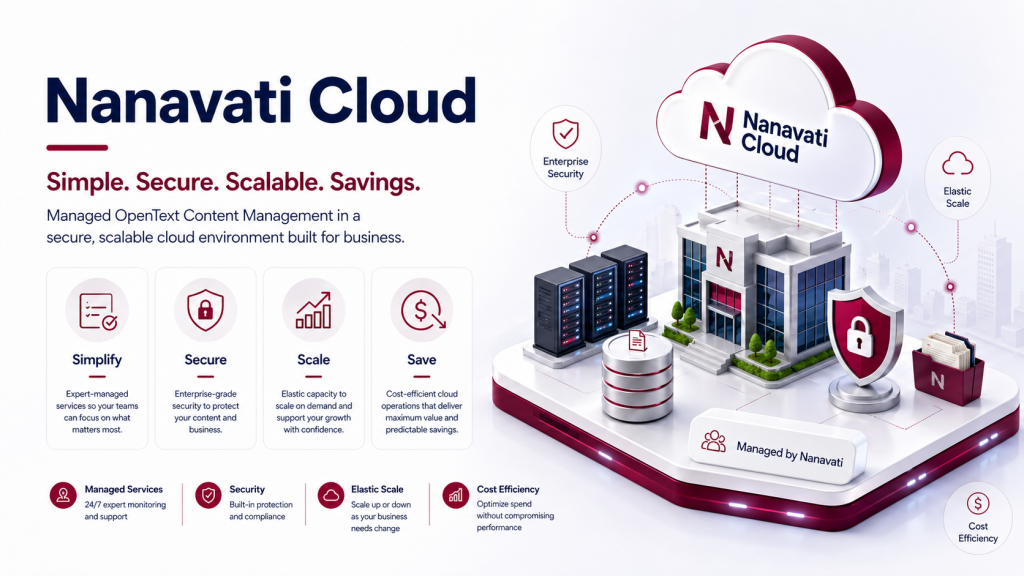
The Nanavati Cloud is a managed, partner-hosted cloud environment purpose-built for OpenText Content Management. It is not OCP and it is not a generic IaaS deployment. It is a dedicated managed service run by OpenText-certified experts with over 20 years of hands-on Content Management experience, built on the OpenText Content Suite platform which carries DoD 5015.2 certified records management status.
For many small to mid-sized organizations, and for larger organizations that want a more hands-on, responsive managed service than OpenText’s own cloud offerings provide, the Nanavati Cloud fills a real gap in the market. Nanavati handles all upgrades, patching, monitoring, security hardening, and technical issue resolution. Customers simply log in and use the system. The environment is elastic, meaning organizations pay for the capacity they actually use rather than over-provisioning for peak loads. And critically, organizations with existing perpetual OpenText licenses can bring those licenses to the Nanavati Cloud, protecting prior investments rather than forcing a full relicense under a subscription model. For customers whose licenses are not transferable, Nanavati offers discounted monthly subscription rates to ease the transition.
The Nanavati Cloud is also particularly well-suited to organizations running older, unsupported versions of OpenText. Rather than managing a complex in-place upgrade on aging infrastructure, customers can migrate to the Nanavati Cloud and arrive on the latest supported version in a single motion, with migration handled by the same team that will manage the environment going forward. Nanavati has published cost comparison analyses showing that in most scenarios, the Nanavati Cloud is less expensive than maintaining an equivalent on-premises deployment when all factors, including hardware, staffing, licensing, and support, are accounted for.
Choosing the Right Path: Key Questions to Ask
No deployment model is universally correct. The right choice depends on a set of organizational realities that are specific to each customer. Before committing to a path, these are the questions worth working through deliberately.
What are your compliance and data residency requirements? Organizations with FedRamp, Protected B, ITAR, or strict data sovereignty mandates need to validate that their chosen model meets those requirements specifically, not just in principle but with documented certifications and audit trails.
What is your current licensing position? Organizations with significant perpetual license investments have more flexibility than is commonly assumed. Both private cloud models and partner-hosted options like the Nanavati Cloud support perpetual license portability. Moving to OCP typically requires a subscription transition that needs to be evaluated financially.
What is your internal IT capacity? On-premises and self-managed private cloud deployments require sustained technical expertise to maintain. If your organization is struggling to keep pace with OpenText’s release cadence or is carrying technical debt from deferred upgrades, a managed service model removes that burden entirely.
What is your AI and modernization roadmap? If OpenText Aviator, Content Aviator, and the broader AI capabilities are on your near-term roadmap, proximity to OCP or an environment that can connect to OCP becomes increasingly important. Organizations planning to stay on-premises long-term may find themselves at a growing feature disadvantage as AI capabilities are prioritized for cloud-native delivery.
Conclusion
The cloud deployment decision for OpenText Content Management is not a binary choice between staying on-premises and moving to OCP. There is a genuine spectrum of options, each with distinct tradeoffs across control, cost, compliance, and capability. OpenText Private Cloud offers sovereign, dedicated infrastructure managed by OpenText itself. OCP delivers the full-featured SaaS path with the deepest AI integration. Hybrid models allow incremental modernization. And partner-hosted options like the Nanavati Cloud offer a compelling middle path: managed, expert-run, cost-competitive, and flexible enough to honor existing license investments. It deserves a seat at the table in any deployment evaluation.
Nanavati Consulting has over 20 years of experience designing, deploying, and managing OpenText environments across all of these models. Whether you are evaluating a move to OCP, considering the Nanavati Cloud as a managed alternative, or working through a hybrid transition strategy, we bring the technical depth and deployment experience to help you make the right call and execute it well.
Contact us today to schedule a free demo and a personalized consultation.